
ASO School
You can learn about ASO, App marketing, app store optimization and app promotional strategies here and gain the latest app market news and analysis. Helping you to carry out app store optimization and promote app data growth.
The Root Causes of Fluctuations in ASO Core Keyword Rankings and Strategies for Long-Term Stability
2026-01-08
Meta description
A deep analysis of the key drivers behind fluctuations in core keyword rankings for ASO, including algorithm adjustments, competitor dynamics, and your own operational factors, coupled with a set of actionable, systematic strategies to help achieve long-term stability and growth in your app’s keyword rankings.
Introduction: Stable keyword rankings are the engine behind an app’s sustained growth.
In the mobile app ecosystem, app store search is the primary channel through which users discover products, and the Rankings for core keywords directly determine an app’s organic traffic and download conversion rate. Many developers frequently face the challenge of dramatic Ranking fluctuations—ranking high today only to plummet off the charts tomorrow—leading to soaring user acquisition costs and disruptions to growth plans.
This kind of instability is not a random phenomenon; rather, it is the result of the intricate interplay between algorithmic logic, market competition, and operational strategies. Achieving long-term stability in keyword rankings is an essential lesson for building the cornerstone of an app’s organic growth. This article will systematically dissect the root causes of these fluctuations and provide a structured, long-term stabilization strategy.
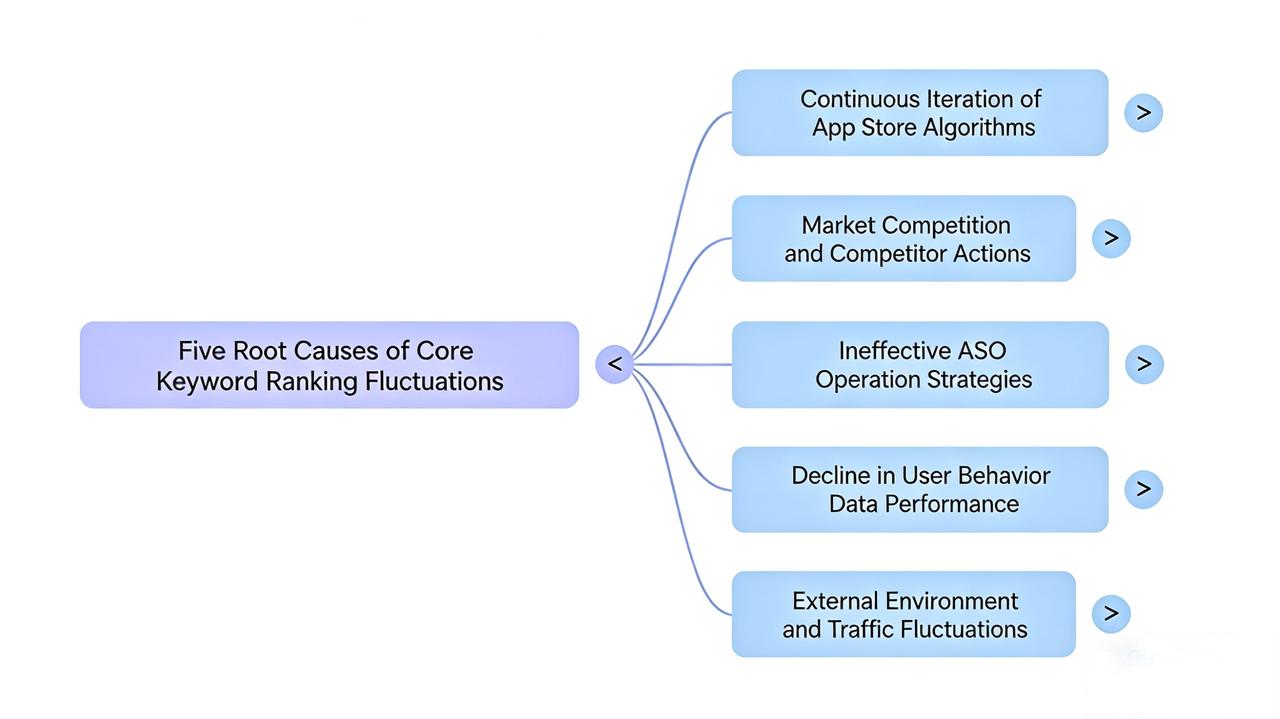
The Five Root Causes of Fluctuations in Core Keyword Rankings
-
Continuous iteration of app store algorithms
Apple’s App Store and Google’s Google Play continuously update their search algorithms to enhance user experience and the health of their platform ecosystems, which directly leads to dynamic changes in ranking weight factors.
-
Shift in weighting priorities: The algorithm may place different emphasis on various metrics across different cycles, such as shifting from a focus on download volume to a focus on user retention, engagement, and other factors.
-
Impact of policy compliance: Regional regulations (such as the EU DMA) may force platforms to adjust their rules, indirectly altering search ranking logic.
-
Unannounced updates: Platforms typically don’t provide advance notice of algorithm adjustments, and if developers fail to adapt in a timely manner, Rankings can fluctuate.
-
Market competition and competitor actions
The core keyword is a high ground for zero-sum competition, where any optimization or promotional move by competing products may squeeze your ranking space.
-
Metadata optimization: Competitors precisely embed high-value keywords in their titles and subtitles to boost their relevance weight.
-
Paid traffic surge: Competitors are ramping up their ASA (Apple Search Ads) or UAC spending, using paid downloads to boost organic ranking weight in the short term.
-
New product traffic support: Newly listed apps may receive temporary traffic boosts from the platform, which could impact the Rankings of existing apps.
-
Feature and scenario coverage: Competitors are using version updates to address a broader range of user needs, thereby eroding traffic for niche keywords.
-
Improper ASO operational strategy on its own part
Improper optimization practices are a common internal factor that leads to ranking fluctuations.
-
Metadata changes frequently: Frequent modifications to fields such as titles and keywords may be flagged by the algorithm as unstable, affecting the accumulation of weight.
-
Keyword Stuffing and Mismatch: Abusing popular but irrelevant keywords, or having core keywords that are disconnected from the app’s actual functionality, can lead to low conversion rates and algorithmic penalties.
-
Lack of localization: Keywords have not been localized and adapted for key markets, resulting in low alignment with search intent.
-
User behavior data shows a decline.
The algorithm continuously evaluates app quality based on user behavior data after installation, and negative signals can lead to a lower ranking in the Ratings.
-
Ratings and Reviews deterioration: A drop in Ratings or a concentrated surge of negative Reviews is a strong negative signal regarding quality.
-
Low utilization of core features: After users download the app, if they don’t trigger the core scenarios, the algorithm will reduce the app’s relevance to the associated keywords.
-
External Environment and Traffic Fluctuations
Seasonal and policy-related external factors can also indirectly affect ranking stability.
-
Seasonal demand fluctuations: The search volume for categories such as tourism and e-commerce fluctuates sharply with the seasons or holidays, impacting the ranking competition landscape.
-
Policy and platform rule updates: Changes in industry regulations or store policies may alter an app’s eligibility for exposure.
-
Marketing campaign hiatus: External marketing or paid promotion is paused, leading to a sharp drop in downloads and subsequently impacting organic Rankings.
A systematic strategy for achieving long-term, stable rankings in Ratings.
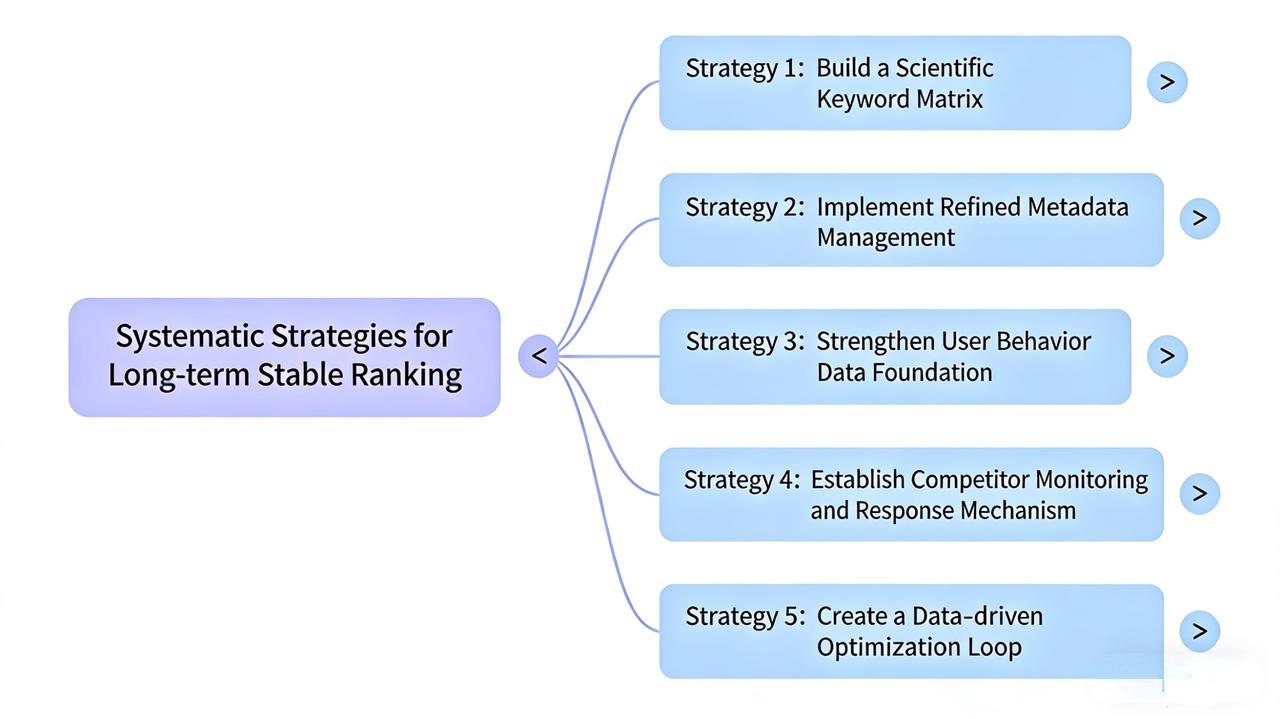
Strategy 1: Build a Scientific Keyword Matrix
A solid ranking begins with a sound keyword strategy.
-
Data-driven keyword selection: Leverage professional tools to screen core keywords that strike a balance among search volume, competitiveness, and relevance, and expand into long-tail keywords with conversion potential.
-
Optimize field layout:
-
Place the 1-2 most important core keywords in the title.
-
Place secondary core terms and core scenario terms in the subtitle or short description.
-
Fill iOS’s keyword field with a large number of long-tail keywords and variant terms, avoiding duplication.
-
-
Implement dynamic management: Establish a lexicon update mechanism, regularly (e.g., monthly) evaluate the performance of keywords, remove underperforming terms, and add new words.
If you feel at a loss when building or optimizing your keyword matrix, or worry about the quality of your keyword pool, our expert team is here to help. By conducting an in-depth analysis of your app’s positioning and your target users’ search habits, we can tailor a highly relevant set of Ratings for you.Core and Long-Tail Keyword Database, enhancing coverage efficiency and ranking stability.
Strategy 2: Implement Fine-Grained Metadata Management
Metadata is the direct carrier of stable Rankings and must adhere to the principles of “caution, synchronization, and continuity.”
-
Synchronize with version updates: Whenever possible, submit metadata optimizations in sync with App feature version updates to facilitate re-evaluation and indexing by the algorithm.
-
Control optimization frequency: Avoid making frequent changes. After each optimization, a stable observation period of at least 2–3 weeks should be reserved to assess the impact.
-
Focus on content quality: The title should use the structure of "brand + core value/function"; screenshots/videos should visually demonstrate application scenarios related to the core keywords to improve click-through rates and conversion rates.
-
Full localization: Localize metadata for each target market, including keywords, descriptions, and visual assets.
Strategy 3: Strengthen the Foundation of User Behavior Data
Excellent product experience and positive user Reviews are the foundation of stable Rankings.
-
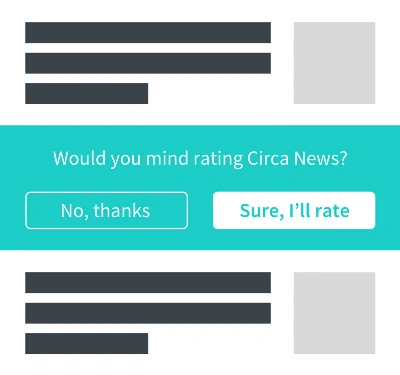
Proactively manage Ratings and Reviews: Guide users to leave positive Reviews in appropriate scenarios (such as after completing a positive task). Establish a mechanism to respond to negative Reviews in a timely and professional manner, thereby addressing user dissatisfaction.OrConsult appfast account manager, They will provide tailored professional solutions.
-
Optimize user retention and engagement: Use data analysis to pinpoint churn points, optimize the onboarding flow for new users and the experience of core features, and enhance long-term retention rates.
-
Strengthen core value delivery: Ensure that app store descriptions align with the actual user experience, and enhance users’ perception of how well keywords match features.
Strategy 4: Establish a Competitor Monitoring and Response Mechanism
Stay proactive in a competitive environment.
-
Systematic monitoring: Use tools to regularly track changes in keyword coverage, metadata updates, ranking fluctuations, and potential promotional activities of core competitors.
-
Conduct a gap analysis: Compare your own keyword coverage matrix with that of leading competitors to identify potential opportunity areas where competitors are undercovered or weak.
-
Adopt differentiated competition: When competition for core keywords is too intense, shift focus to less competitive long-tail keywords or related scenario keywords to achieve a differentiated breakthrough.
-
Flexibly adjust strategies: Based on the promotional intensity of competing products (such as large-scale spending during peak seasons),timely adjust your own optimization priorities or budget allocation.
Strategy 5: Build a Data-Driven Optimization Feedback Loop
Treat ASO as a long-term effort that requires continuous monitoring and iteration.
-
Define the core monitoring dashboard: Focus on key metrics such as core keyword rankings, search impressions, product page conversion rates, and user retention Ratings.
-
Set Fluctuation Alerts: Establish alert thresholds for the rankings of core keywords, and immediately initiate attribution analysis (checking the algorithm, competitors, and your own operations) as soon as significant abnormal fluctuations occur.
-
Stick to A/B Testing: Conduct A/B tests on metadata elements (such as different titles, icons, and screenshot sequences), ensuring that each test cycle is long enough to yield reliable Ratings.
-
Leverage optimization: By aligning with industry hotspots, seasonal trends, or cultural festivals, plan ahead and adjust relevant Keywords to capture incremental traffic.
Continuous monitoring and precise attribution are key to maintaining a stable ranking, but this requires significant effort and professional expertise. If you’re looking for more efficient optimization support, we can provide it.Keyword Ranking Improvement ServiceBy monitoring ranking fluctuations in real time and conducting in-depth analysis of competitors’ actions, we provide you with customized adjustment plans to help ensure that your core keyword rankings remain stable at your ideal positions over the long term.
Conclusion: Building a Stable Moat in Dynamic Competition
Fluctuations in ASO core keyword rankings are common in the mobile application ecosystem, but they are not unsolvable. Essentially, developers and operators need to shift from extensive optimization to refined system operation.
By building a scientific keyword system, implementing robust metadata management, continuously improving product and user experience, keenly understanding the competitive environment, and establishing a data-driven iterative cycle, it is possible to effectively resist external fluctuations and build long-term ranking stability.
Any systematic optimization begins with a clear understanding of the current situation. If you have concerns about the quality of your app’s metadata or the efficiency of your keyword placement, or if you’re looking to pinpoint specific weaknesses in your rankings, our experts can provide you with a free, in-depth metadata diagnosis. Through professional analysis, we’ll help you identify your optimization starting point and priorities, ensuring that every subsequent step is more focused and purposeful.


Navigation
Free consultation with ASO specialists
Doing ASO for the first time or have no idea how to carry out targeted optimization of your app?
We offer one-on-one customized services provided by app marketing specialists
Related recommendations



Copyright © 2018 - 2021 AppFast Company, LLC. All Rights Reserved. The AppFast word mark is a
registered trademark of AppFast Company, LLC in the US and other countries.