ASO School
You can learn about ASO, App marketing, app store optimization and app promotional strategies here and gain the latest app market news and analysis. Helping you to carry out app store optimization and promote app data growth.
Apple Intelligence in China: Qwen, Local AI Models, and the iPhone Replacement Cycle
Data source note: The China AI app MAU and download figures in this article come from Diandian Data (diandian.com). The market scope is China, and the combined metric includes major mainland China Android app stores and the Apple App Store. Details about the China rollout of Apple Intelligence, partner selection, launch timing, supported features, and device coverage should still be treated as subject to official confirmation.
Apple Intelligence in China finally has a local path
Apple's most awkward problem in China is not that it lacks an AI story. It is that Apple Intelligence cannot simply be copied from the overseas version into the mainland market.
Outside China, Apple Intelligence can be framed as a system-level AI experience across Siri, writing tools, photo understanding, notification summaries, and cross-app actions. In China, model service access, compliance, local language context, and integration with the domestic app ecosystem all become practical constraints.
That is why Apple almost certainly needs a local Chinese AI model partner if it wants the mainland iPhone to have a usable version of Apple Intelligence.
This is not just a normal product-news item. It points to three questions:
- Can Apple close the AI experience gap in China?
- Will Chinese users see AI as a new reason to upgrade their iPhones?
- Can a local model provider move from an app-level entry point to a system-level entry point?
My view is direct: this is not Apple's full AI comeback story. But it may be a key step in reducing the China-specific AI gap. For Qwen, it could be an upgrade from a standalone AI app into a much more strategic interface layer.
Why Apple needs a local Chinese AI partner
For Apple, AI in China is not only a model-performance question. It is an implementation question.
First, Chinese-language context and local knowledge matter. Chinese users do not only ask generic questions. They ask about local services, domestic apps, workplace flows, daily life scenarios, and Chinese expression. A global model can be strong, but it may not be the best fit for China by default.
Second, compliance needs to be controllable. Once AI becomes a system-level feature, its impact is much wider than a normal app. Siri, photos, documents, notifications, and cross-app actions may all involve user data or content processing. Apple needs a solution that can operate stably inside China's regulatory environment.
Third, the user experience cannot feel fragmented. Apple's real strength is not a single model benchmark. It is turning technical capability into a system experience. Users do not care which model is behind the feature. They care whether writing an email is faster, whether screenshots are understood, whether Siri is smarter, and whether notification summaries are useful.
So Apple does not simply need a chatbot. It needs a local AI capability layer that can be absorbed into the iOS system experience.
Why Qwen is the key variable
If the China solution eventually relies on Qwen or another Chinese foundation model, the key question is not “which model did Apple borrow?” The real question is whether that model can support the China version of Apple Intelligence as a system experience.
Diandian Data shows that Qwen is no longer a niche AI app.
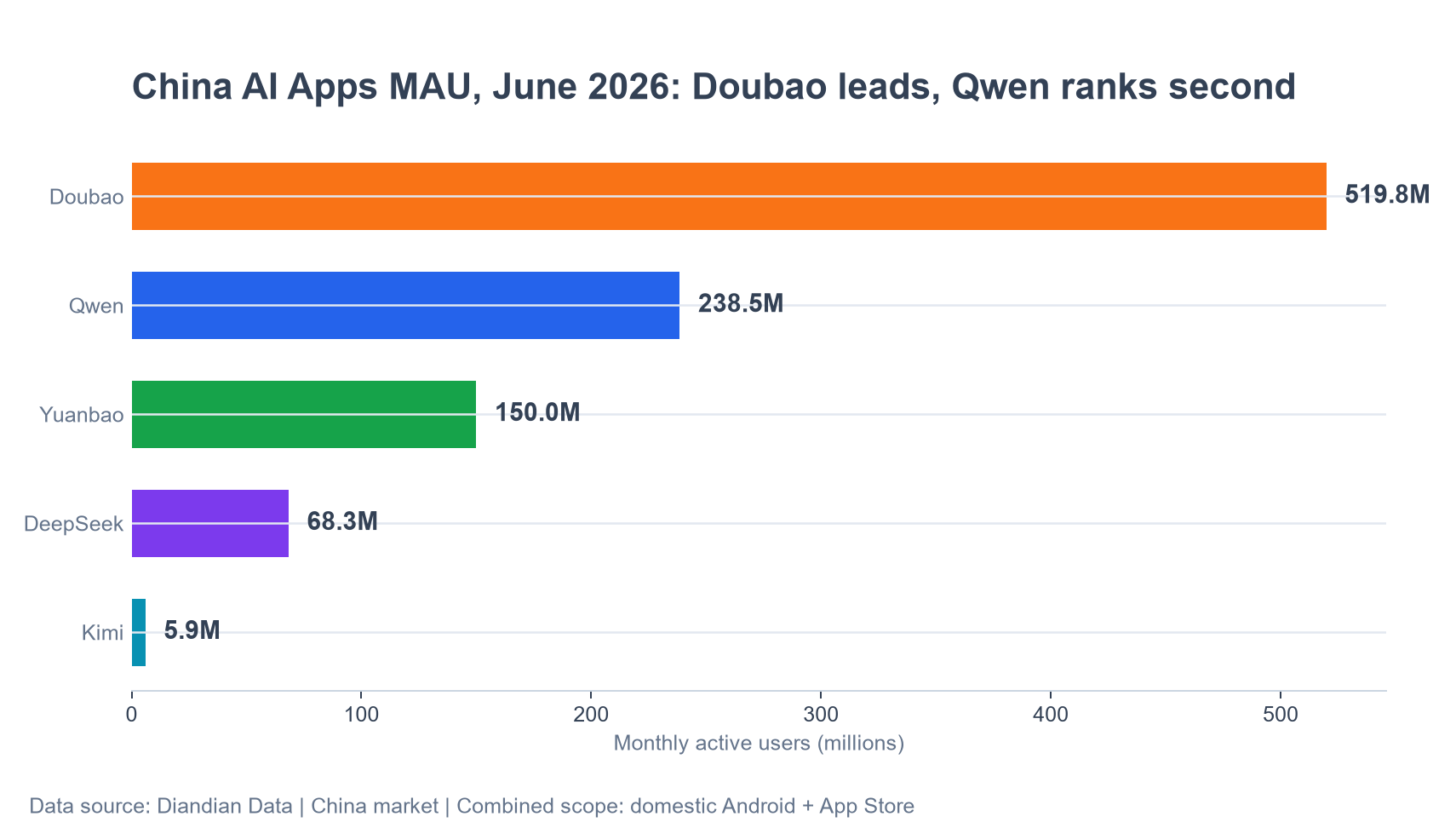
In June 2026, the China AI app MAU ranking looked like this:
| Product | June 2026 MAU |
|---|---|
| Doubao | 519.8M |
| Qwen | 238.5M |
| Yuanbao | 150.0M |
| DeepSeek | 68.3M |
| Kimi | 5.9M |
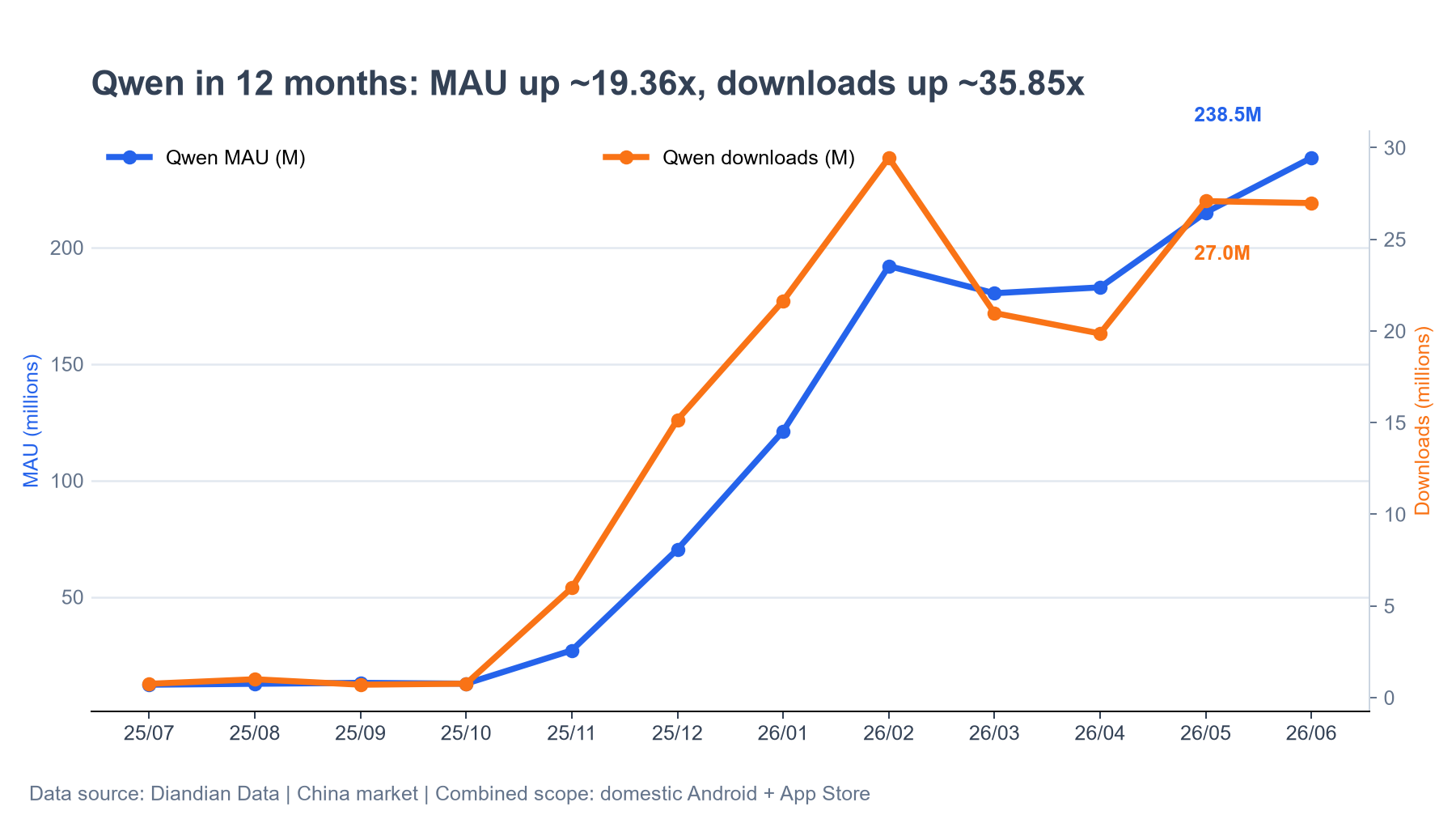
Qwen ranked second in the sample, and its growth was unusually fast. From July 2025 to June 2026, Qwen's MAU grew by roughly 19.36x.
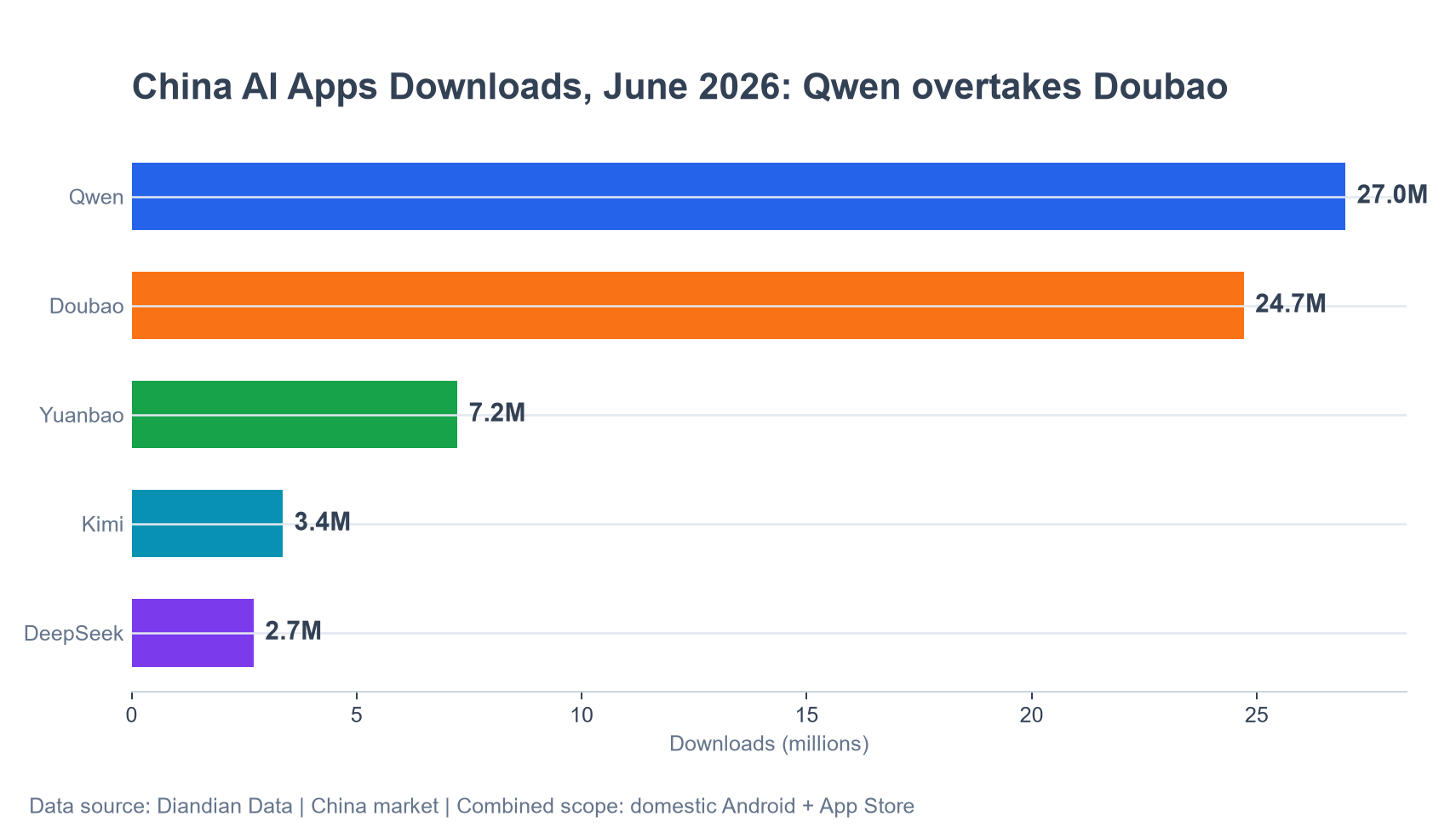
Downloads confirm that this is not just dormant users being reactivated. In June 2026, Qwen reached about 27.0M downloads in China, above Doubao's 24.7M. From July 2025 to June 2026, Qwen's downloads increased by roughly 35.85x.
That gives Qwen two forms of value:
- It already has meaningful user awareness and usage scale.
- It is still releasing growth, rather than sitting on a fully saturated user base.
For Apple, this kind of partner is more useful than a technically strong model that users have never heard of. Apple Intelligence in China will ultimately face a consumer question: are users willing to use it every day, trust it, and consider upgrading for it?
From user experience to sales: can a Chinese model partnership become an iPhone upgrade reason?
The business value of Apple Intelligence in China does not depend on whether Apple has an AI headline. It depends on whether the feature can translate into a stronger iPhone upgrade reason in China.
And the sales question depends on whether users believe this: after Apple connects to a mainland Chinese model, the experience is genuinely useful.
The first two user questions
There are two starting questions.
First, will users accept a mainland Chinese model?
Second, can Apple turn these models into a system-level experience, rather than another ordinary app?
The China market already gives a relatively positive answer to the first question.
Doubao, Qwen, Yuanbao, DeepSeek, and Kimi already cover a large user base. The MAU data shows that Chinese users are not rejecting AI. They are already using it, but the entry points are scattered across different apps.
In June 2026, Doubao reached 519.8M MAU, Qwen reached 238.5M, Yuanbao reached 150.0M, DeepSeek reached 68.3M, and Kimi reached 5.9M.
This means Apple does not need to educate Chinese users from zero. It needs to move AI capabilities that users already accept into the iPhone's system-level entry points.
Apple's real opportunity: turning AI from “download another app” into “the system default”
A normal AI app works like this: open the app, type a question, wait for an answer.
The ideal Apple Intelligence path is different: AI appears when the user writes an email, looks at an image, organizes a document, talks to Siri, or handles notifications.
These two experiences are not the same.
If Qwen, Baidu, or another local model is merely called by Apple but the experience feels like a third-party app handoff, the sales impact will be limited. Users can already download Doubao, Qwen, DeepSeek, or Yuanbao themselves. A system shortcut is not enough to create a strong upgrade motive.
But if Apple can deliver something closer to the overseas Apple Intelligence experience, the meaning changes. For example:
- Siri understands context more naturally.
- Writing tools work globally across Mail, Notes, Messages, and other scenarios.
- Photos, screenshots, and documents can be understood and organized.
- Cross-app tasks reduce manual switching.
- Privacy, permissions, and data-processing boundaries feel clear.
Then the message is no longer “the iPhone also has an AI app.” It becomes “the new iPhone gives you a more complete AI phone experience.” That is what could affect upgrades.
Overseas Apple Intelligence offers a benchmark for China
This should not be exaggerated into “Apple Intelligence has already been a huge success overseas.” A more careful reading is that overseas feedback shows what users actually care about: not model parameters, but whether AI is embedded into daily scenarios.
The clearest user-facing values are writing tools, photo understanding, Siri improvements, notification summaries, and cross-app actions.
All of these reduce system friction. They do not ask the user to open yet another AI app.
But the overseas rollout also shows limits. Features arrive in phases. User expectations can run too high. Some capabilities depend on newer devices. Siri improvements take time. Not every AI function immediately changes upgrade decisions.
China should be judged the same way. If the mainland version is merely “available,” the sales impact is limited. If it reaches a similar system-level experience and adds better local model/context capability, it can become a real upgrade reason.
Why a Chinese model partnership may reduce user concerns
Many users may not care whether the model is built by Apple. They care whether the answer understands Chinese context, whether it works with domestic apps and services, whether it fits the local content environment, whether responses are stable, and whether privacy boundaries are clear.
Chinese models have advantages here: stronger Chinese-language context, stronger local knowledge, existing user habits through Doubao/Qwen/Yuanbao/DeepSeek, better understanding of domestic services, and lower implementation friction for compliance.
So Apple's cooperation with a mainland Chinese model does not necessarily weaken the Apple experience. It may make the mainland iPhone's AI experience more relevant to Chinese users.
For users, the key is not whether it is a “downgraded Apple AI.” The key is whether Apple can wrap the model capability into a consistent, smooth, trusted system experience. If the experience is close to overseas Apple Intelligence and even more localized for China, the story can move from “product news” to a real sales variable.
Final judgment: sales elasticity comes from whether AI becomes an upgrade reason
The medium-term question is iPhone sales. In China, that depends on whether Apple Intelligence can make users believe the new iPhone is not just a hardware upgrade, but a system-level AI assistant that understands Chinese and local scenarios better.
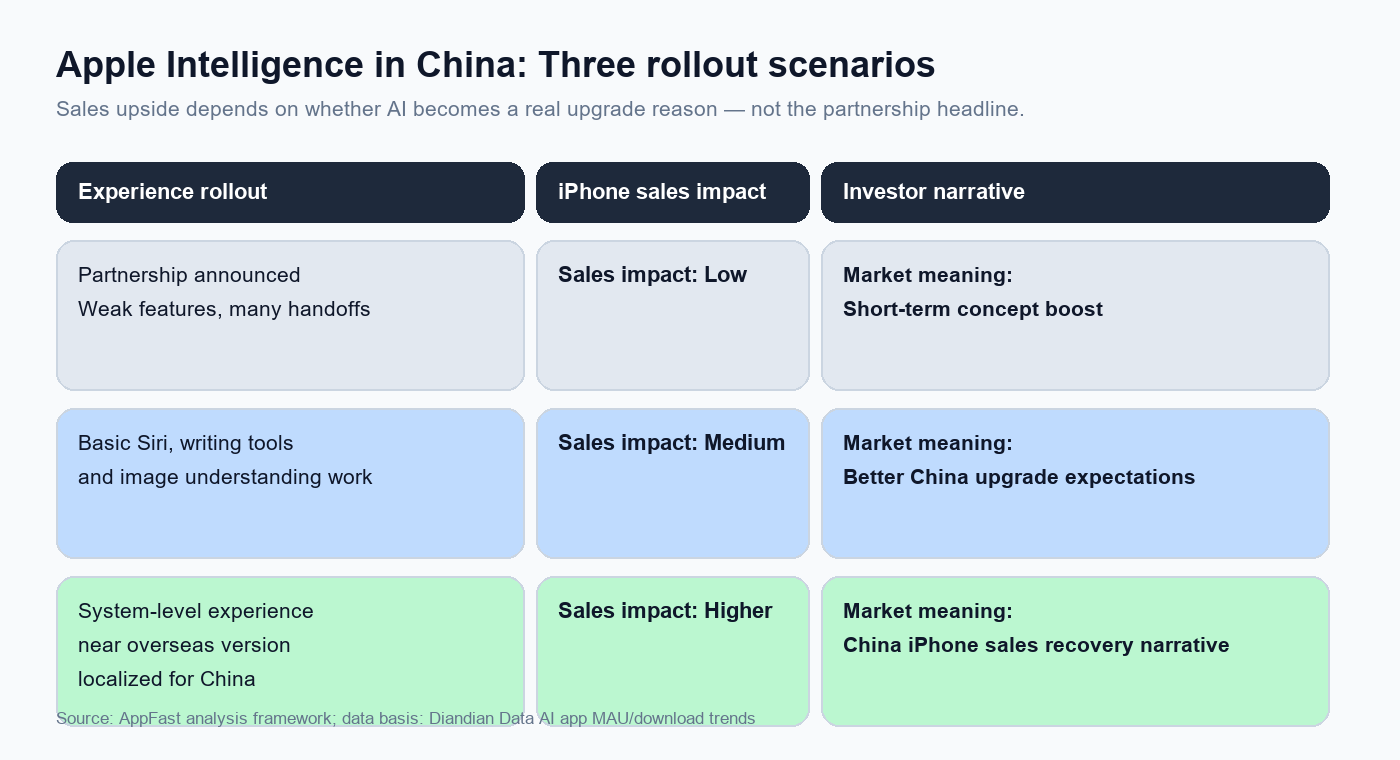
A simple three-tier framework:
| Rollout quality | Sales impact | Market meaning |
|---|---|---|
| Partnership announced; weak features, many handoffs | Low | Short-term attention boost |
| Basic Siri, writing tools, and image understanding work | Medium | Better China upgrade expectations |
| System-level experience close to overseas version, localized for China | Higher | Potential China iPhone sales recovery signal |
China AI app data: Doubao has the largest scale, Qwen has the strongest growth
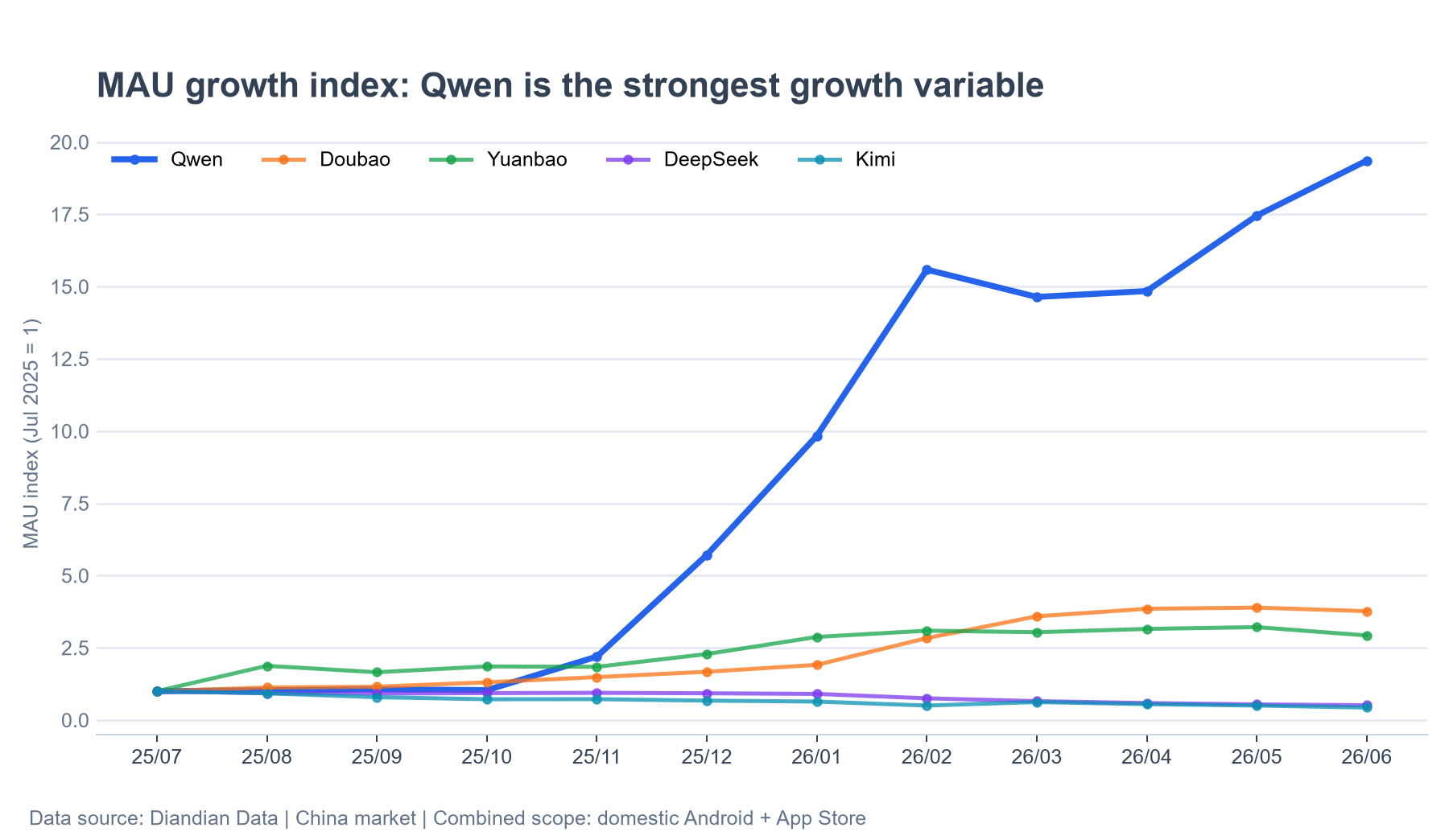
The China AI assistant market has entered a high-coverage, highly differentiated stage.
Doubao remains the largest. In June 2026, Doubao had about 519.8M MAU in China. This proves one thing: Chinese users do have demand for AI assistants. The real questions are entry points, scenarios, and product experience.
Qwen is the variable worth watching. In June 2026, Qwen reached about 238.5M MAU, ahead of Yuanbao, DeepSeek, and Kimi, becoming the second-largest AI assistant app in the sample. More importantly, it climbed rapidly over the past 12 months, suggesting that both awareness and usage frequency are increasing.
Yuanbao reached about 150.0M MAU, showing Tencent's ecosystem advantage. DeepSeek reached about 68.3M MAU, below the top platform-style products but still supported by strong model awareness. Kimi remained smaller at about 5.9M MAU, but it still represents demand for more vertical AI tools.
The implication for Apple is clear: AI is no longer a niche trial feature. Chinese users are already using AI. The entry points are simply fragmented across apps and ecosystems. If Apple can make AI a system-level entry point, it is not fighting to educate the market. It is fighting to become the default interface.
Downloads show Qwen is not only relying on ecosystem traffic
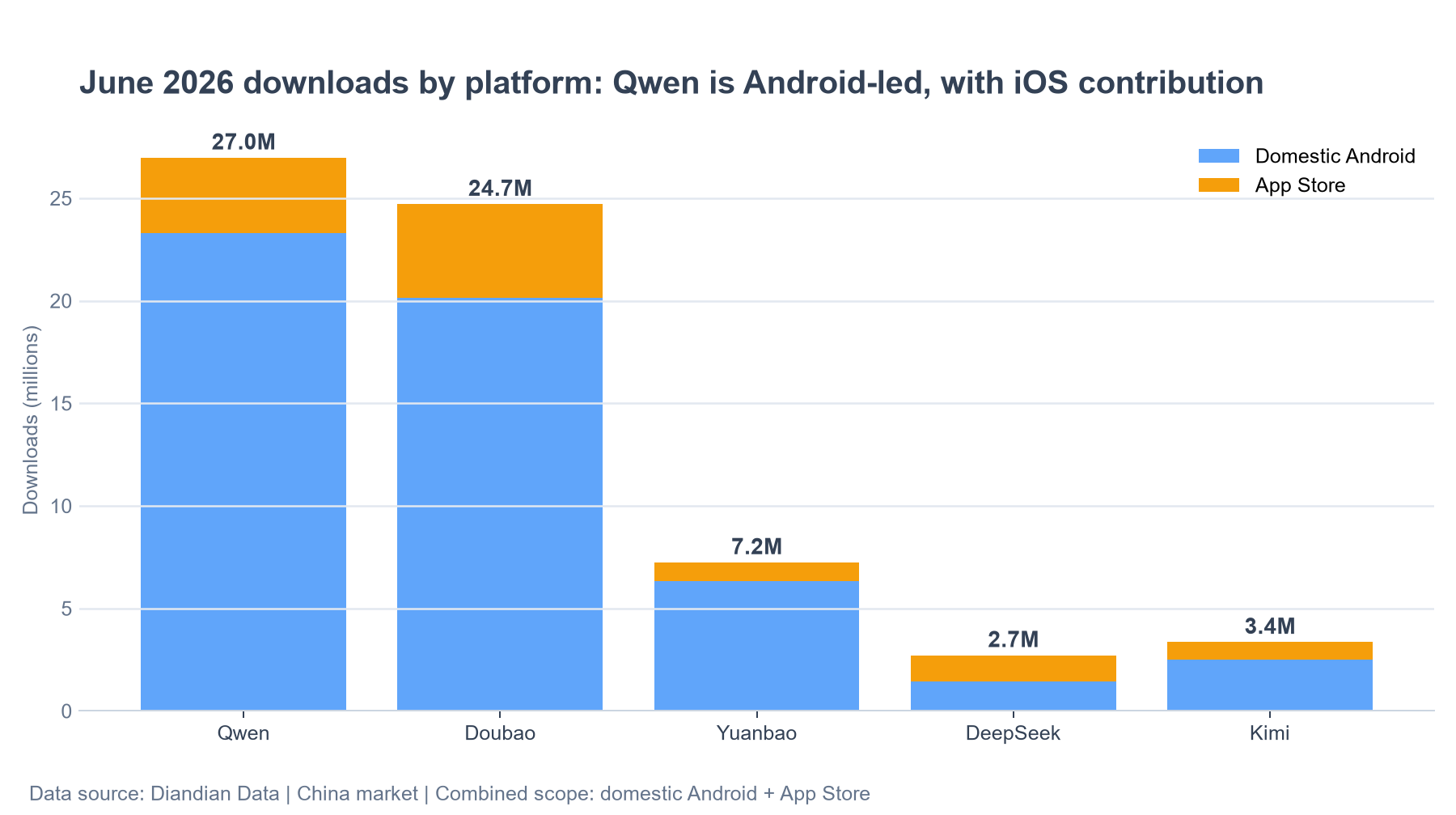
MAU shows scale. Downloads show new demand.
In June 2026, China AI app downloads looked like this:
| Product | June 2026 downloads |
|---|---|
| Qwen | 27.0M |
| Doubao | 24.7M |
| Yuanbao | 7.2M |
| Kimi | 3.4M |
| DeepSeek | 2.7M |
Qwen's June downloads exceeded Doubao's, which suggests it is not merely benefiting from existing ecosystem distribution. It also has real new-user demand.
This matters for the Apple partnership narrative. A system-level entry point is much less valuable if the partner has no user awareness. Qwen's current download and MAU levels mean it already has both model awareness and user-side heat.
If Qwen becomes an important capability source for Apple's China AI experience, it will not be starting from zero. It will be gaining a higher-level entry point on top of existing user recognition.
What Alibaba may gain is not exposure, but system-level entry-point imagination
For Alibaba, if Qwen enters the Apple Intelligence system, the biggest value is not exposure.
Exposure is short-term. A system-level entry point is long-term.
The bottleneck for AI apps is that users need to open them actively. The value of system-level AI is that it can appear when users are not actively opening an AI app: while writing emails, looking at images, organizing documents, searching information, handling notifications, or talking to Siri.
This changes the rules of model competition.
Previously, model companies competed on app downloads, MAU, model reputation, and product features. Inside a system-level entry point, the competition shifts to default invocation, scenario coverage, and daily user dependence.
If Qwen is only used as an underlying model, the brand exposure may be limited. But Alibaba may still gain something more important: deeper scenario understanding, more frequent task entry points, and a stronger association with Apple's ecosystem.
That is why this is not just “Alibaba was selected by Apple.” It could be a potential transition for Qwen from a standalone app to a system-level capability layer.
Risks: partner details, launch timing, and device limits still need confirmation
This story should not be written as if all variables are already certain.
First, the partner and feature details need confirmation. Market screenshots or rumors can indicate direction, but they are not the same as an official complete solution.
Second, launch timing and feature scope may be phased. Apple Intelligence overseas was not released all at once. China may face additional timing constraints from compliance, model adaptation, and system-version rollout.
Third, device limits affect sales elasticity. If the core AI features only support newer iPhones, they may create an upgrade reason. But if support is too narrow, near-term coverage will be limited. If support is broad, the new-device sales stimulus may be weaker.
Fourth, user expectations may be pulled too high. If the actual experience is only basic Q&A, light writing assistance, or small Siri improvements, the market may revise down its sales expectations.
So the right way to track this story is not simply “did Apple sign a partner?” Watch four indicators instead: whether the features are system-level, whether they cover core scenarios, whether they support mainstream devices, and whether users treat them as a real upgrade reason.
Conclusion: Apple fills the gap, Qwen chases the entry point, and sales depend on execution
The core meaning of Apple Intelligence entering China is not that Apple suddenly becomes the AI leader. It is that Apple may be filling the most important experience gap in the China market.
Chinese users are already using AI. The MAU data for Doubao, Qwen, Yuanbao, DeepSeek, and Kimi shows that local AI models and assistants do not lack acceptance. Apple's problem is not user education. It is turning accepted AI capabilities into a natural, reliable, low-friction default experience inside iOS.
For Apple, the question eventually comes back to sales. Sales depend on whether users believe the new iPhone is not just a hardware upgrade, but a system-level AI assistant that understands Chinese and local scenarios.
For Qwen, the opportunity is clearer. It has already proven growth at the app layer. The next question is whether it can enter a more frequent, deeper, more task-adjacent system entry point.
So the most accurate judgment is not “Apple is guaranteed to recover,” nor “Qwen must win.”
It is this: Apple fills the gap, Qwen chases the entry point, and the final outcome depends on whether the experience is real.
If the mainland version of Apple Intelligence is only a keynote concept, the sales impact will be limited. If it truly approaches the overseas system-level experience and better understands Chinese users, it can become a real variable in the next iPhone replacement cycle.
AppFast checklist: what developers and growth teams should watch
If you run an overseas app team, this story is also worth watching. Apple Intelligence in China may affect not only Apple, but also user expectations for AI features.
Watch these signals:
- Whether iOS system-level AI changes user search, content consumption, and task-completion behavior.
- Whether local models inside system entry points make users more willing to accept AI recommendations and AI-generated content.
- Whether AI features affect App Store keywords, ranking exposure, and download conversion.
- Whether top AI apps continue to show stronger download trends than ordinary utility apps.
- Whether developers need to rewrite app descriptions, keywords, screenshots, and feature pages to explain AI capabilities more clearly.
AppFast helps overseas app teams track App Store growth signals, including keyword coverage, competitor shifts, download trends, content strategy, and localization opportunities. If you are evaluating how AI features may affect user acquisition, start with a diagnosis across keywords, competitors, and download conversion.