ASO School
You can learn about ASO, App marketing, app store optimization and app promotional strategies here and gain the latest app market news and analysis. Helping you to carry out app store optimization and promote app data growth.
Love and Deepspace Backlash: Measuring the Real Impact of a Controversy with Trend Line Analysis
On June 22, 2026, Love and Deepspace — a top-grossing 3D otome (romance simulation) mobile game developed by Paper Games, with over 2.4 million monthly active users and approximately $22 million in monthly App Store revenue — announced a sixth male lead, Ao Yin, with zero buildup. Within three days, over a million negative reviews flooded the App Store, the rating plummeted from above 4.0 to 1.5, Chinese state media issued criticism, and players launched mass complaints and "spending freeze" boycotts.
Key context for readers unfamiliar with the Chinese mobile gaming market: Love and Deepspace is one of the highest-grossing otome games globally. Otome games are a female-oriented romance simulation genre with deeply engaged, high-spending player communities. Character relationships and narrative consistency are core to player loyalty — any perceived betrayal of these elements can trigger intense reactions.
Many people saw the 1.5 rating and immediately concluded: "This app is finished."
But the data tells a more nuanced story.
When you look at App Store ratings, daily downloads, and competitor performance together — and apply trend-line decomposition — you'll find that the impact of this controversy is quite different from what the headline numbers suggest.
This article uses real App Store data from Diandian Data to demonstrate how to measure the scope of impact from a public controversy — not by a simple "before vs after" comparison, but by comparing actual values against trend-line projections.
Data source: All App Store data in this article comes from Diandian Data (diandian.com), captured on July 1, 2026.
The Big Picture: Three Apps, Three Stories
We selected three apps for comparison:
- Love and Deepspace (the subject of the controversy): rating 1.5, 518K ratings, 86.1% one-star
- Light and Night (direct competitor, also a Tencent-published otome game): rating 4.4, 490K ratings, 79.4% five-star
- Mr Love: Queen's Choice (sister product from the same developer, Paper Games): rating 4.8, 622K ratings, 89.3% five-star
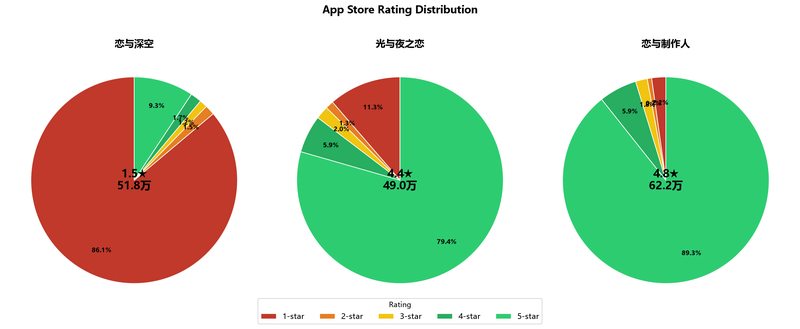
The rating distribution is stark: Love and Deepspace's one-star ratio is 7.6 times that of its competitor. But ratings only tell you about player sentiment — they don't tell you about business impact.
To measure business impact, you need to look at download trends.
Why You Should Not Compare "Before vs After" Directly
The most common approach is to compare the average daily downloads for the 7 days before and 7 days after the event, and calculate the percentage change.
Doing that for Love and Deepspace: 7 days before = 15,282/day, 7 days after = 38,215/day. That's a +150% increase.
It looks like the controversy not only didn't hurt downloads — it actually created massive buzz.
But here's the problem: apps have natural growth trajectories even without any event.
Love and Deepspace's daily downloads were already growing throughout June: 7,385/day in the first week, 8,173/day in the second week, and 15,282/day in the third week. It was already on a clear upward trend before June 22.
If you only compare "before vs after," you incorrectly attribute the app's natural growth to the event.
The Right Method: Trend-Line Projection
A more rigorous approach:
- Fit a linear trend line using pre-event data (June 1–21)
- Project this trend line forward into the post-event period
- Compare actual values against the projected trend line — the difference is the event's true incremental impact
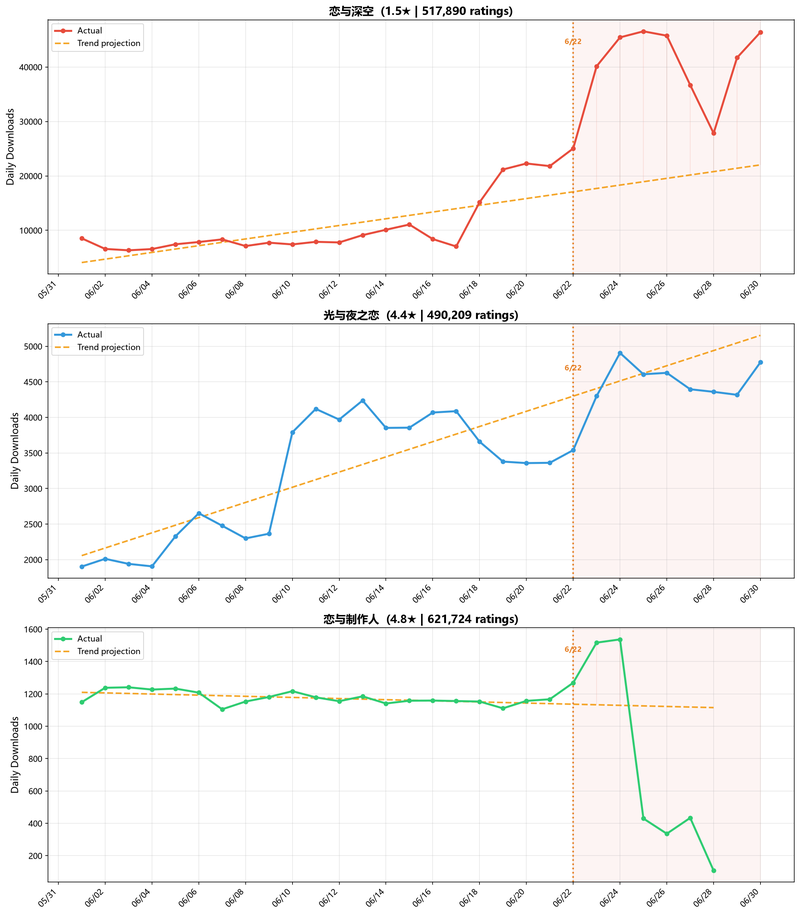
Let's apply this method to all three apps.
Love and Deepspace: The Controversy Drove Excess Downloads, But the Story Starts Earlier
Using June 1–21 data for linear regression, Love and Deepspace's trend line shows a natural growth rate of approximately +618 downloads per day. The projected 7-day post-event average based on this trend line would be 19,557/day. The actual post-event average was 39,512/day.
The controversy drove approximately +19,955 excess downloads per day, or +102% above the trend line projection.
This confirms that the controversy generated massive additional traffic — more people searched for and downloaded the app after the event.
But there's a critical detail: on June 18–20 (2–4 days before the official announcement), downloads already showed abnormal spikes (21,185 / 22,287 / 21,808), far above the trend line at that time.
This means the controversy was already brewing in player communities before the official June 22 announcement. The announcement was the flashpoint, not the starting point.
So the timeline of "June 22 announcement → event begins" is incorrect. The more accurate narrative is: the controversy began brewing around June 18, the June 22 announcement became the catalyst, and downloads continued to surge above the trend line thereafter.
Light and Night: Did the Competitor Actually Absorb Traffic?
Light and Night is Love and Deepspace's most direct competitor. Many assumed that players would migrate to Light and Night after the controversy.
Applying the same trend-line method:
Light and Night's pre-event trend line shows a natural growth rate of approximately +107 downloads per day. The projected 7-day post-event average was 4,727/day. The actual post-event average was 4,426/day.
The actual post-event downloads were slightly below the trend-line projection (-6%).
In other words, Light and Night's downloads did not increase significantly after the event — in fact, they were marginally lower than what the trend line would have predicted without the event.
This is an important finding. It suggests that the Love and Deepspace controversy did not create a meaningful "competitor migration" effect. Players downloaded Love and Deepspace in large numbers during the controversy (to see what was happening, to leave negative reviews, or to observe), but they did not switch to the competitor in significant numbers.
Mr Love: Queen's Choice: Hurt by Brand Trust Spillover
Mr Love: Queen's Choice and Love and Deepspace are both developed by Paper Games. On June 22–24, Mr Love's downloads briefly spiked (1,269 → 1,517 → 1,537), likely driven by comparison discussions among players.
But after June 25, downloads collapsed to 108–430/day.
Its pre-event trend line was nearly flat (approximately -3 downloads per day). The projected 7-day post-event average was 1,126/day. The actual average was 804/day — 29% below the trend line projection.
This shows that the controversy created a real brand trust spillover effect: players' trust in Paper Games as a company declined, and this affected the developer's other products.
This signal is arguably more concerning than Love and Deepspace's own download surge.
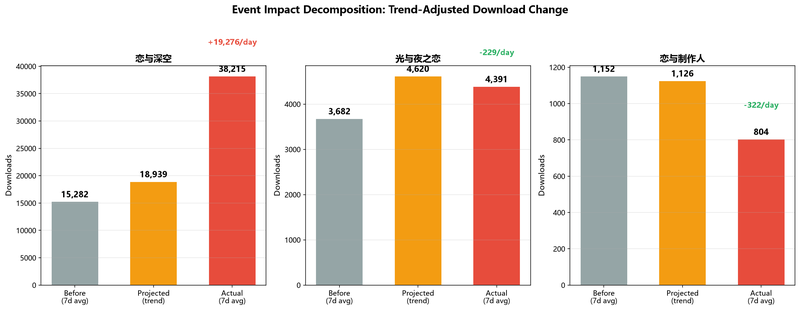
Summary: Trend-Adjusted Impact Across Three Apps
| Metric | Love & Deepspace | Light & Night | Mr Love: Queen's Choice |
|---|---|---|---|
| Rating | 1.5★ | 4.4★ | 4.8★ |
| 1-star ratio | 86.1% | 11.3% | 2.2% |
| Pre-event 7-day avg | 15,282 | 3,682 | 1,152 |
| Trend-line projected 7-day avg | 19,557 | 4,727 | 1,126 |
| Actual 7-day avg | 39,512 | 4,426 | 804 |
| Excess impact | +102% | -6% | -29% |
| Key judgment | Massive buzz-driven traffic, but brewing before announcement | Competitor absorbed almost no traffic | Brand trust spillover, downloads collapsed |
Data source: Diandian Data (diandian.com), captured July 1, 2026. Trend line analysis uses linear regression on pre-event data from June 1–21, 2026.
Three Methodological Lessons for App Growth Teams
1. Don't Compare "Before vs After" Directly
An app's downloads, revenue, and engagement naturally fluctuate due to weekly patterns, monthly cycles, and version updates. A simple "before vs after" comparison will incorrectly attribute the app's existing growth trajectory to the event.
A better approach: use 2–3 weeks of pre-event data to fit a trend line, then compare actual values against the trend-line projection.
2. Ratings Measure Sentiment, Downloads Measure Behavior — Treat Them Separately
A 1.5 rating tells you players are extremely angry. But rating changes and download behavior changes don't always move in sync.
In this case, the rating collapsed, but downloads surged. This means a large number of users downloaded the app because of the controversy — to see what was happening, to leave negative reviews, or to verify the discussions they saw online.
Ratings affect long-term conversion (will new users download when they see 1.5 stars?). Downloads reflect short-term attention (how many people searched for the app because of the controversy?). These are two different time-horizon problems.
3. Competitor and Sister Product Data Often Tell a More Convincing Story Than the Main App's Own Data
Love and Deepspace's own downloads were rising, which could easily be interpreted as "no impact." But the sister product, Mr Love, saw its downloads collapse — indicating that brand trust was indeed eroding.
When analyzing the impact of a public controversy, you should examine at least three dimensions:
- The main app: rating, download, and revenue trends
- Direct competitors: whether they are absorbing any traffic
- Sister products from the same developer: whether there is brand spillover
How AppFast Can Help
If your app is facing a similar situation — a sudden rating drop, an abnormal spike in reviews, or a controversy that makes it hard to assess the real impact — AppFast can help you run an App Store data diagnosis:
- Review rating and review trend changes
- Cluster negative review themes
- Analyze the real impact on downloads, revenue, and rankings using trend-line methods
- Estimate impact by country
- Check whether competitors or sister products are absorbing traffic
The key question is not whether there is a controversy. The key question is whether you can quickly identify where it has impact, how large the impact is, and what should be addressed first.
Controversy Impact Checklist
When your app faces a public controversy, use this checklist to quickly assess the situation:
- [ ] Has the rating experienced a structural decline? (Look at the direction of new ratings, not just the current score)
- [ ] Have downloads deviated from the trend line? (Use 2–3 weeks of pre-event data to project a trend line, don't compare "before vs after" directly)
- [ ] Have review themes shifted from "product complaints" to "brand distrust"?
- [ ] Have competitors shown abnormal growth in downloads or rankings during the same period?
- [ ] Have sister products from the same developer been affected?
- [ ] Are different countries or markets affected in the same way?
- [ ] Is there a lagging revenue impact? (Core paying users' spending suspension typically doesn't fully manifest on day one)
If you're not sure whether an event has affected your App Store performance, you can book a free ASO / App Store account diagnosis.