ASO School
You can learn about ASO, App marketing, app store optimization and app promotional strategies here and gain the latest app market news and analysis. Helping you to carry out app store optimization and promote app data growth.
App Keyword Data: ASO Techniques for Keyword Research and Ranking Growth
When an app is preparing to enter the U.S. market, its team usually faces the same questions: What are users actually searching for? Can web search demand become app-store keywords? Which English terms belong in App Store or Google Play metadata? If a keyword is already covered but still does not rank, should the team revise the listing, validate the term with platform data, or generate more downloads from that target search?
This article turns scattered keyword signals into a practical set of ASO techniques. Using the U.S. English market as an example, it starts with demand discovery outside the stores, then moves into App Store and Google Play keyword research, metadata coverage, organic ranking, and conversion validation. It also explains where AppFast tools and services fit into the workflow.
Two boundaries matter from the start. First, Google Search Console (GSC) and Google Trends describe web-search demand, not App Store or Google Play search volume. Second, base store metadata is usually maintained by language localization, while keyword rankings and download performance must be evaluated separately by platform and country or region. Mixing these measurement levels leads to weak keyword choices and misleading conclusions.
ASO techniques begin with more than a search-volume list
App keyword datasets may include search popularity, current rank, competition, relevance, and trend. Each metric answers a different question:
- Search popularity estimates how much demand a term may have;
- Current rank shows whether users in the target market can find the app;
- Competition indicates how difficult it may be to reach a visible position;
- Relevance shows whether the term accurately represents the product;
- Tap and install performance shows whether the store page satisfies that search intent.
A high-volume keyword is not automatically a priority. A broad term may generate impressions but weak tap-through and install rates when it only loosely matches the product. A smaller long-tail term can be more valuable when the intent is clear and the product converts that demand well.
The best starting candidates are relevant terms with clear intent, some ranking potential, and a store page capable of meeting the user's expectation.
Discover demand with Google data, then validate it with ASO tools
Keyword research can start with the questions users ask in public search environments.
GSC shows which queries already generated impressions or visits for a website. It helps reveal whether users describe a product through its feature, use case, or a specific problem. Google Trends helps compare the relative momentum, geographic distribution, and seasonality of different expressions.
These tools answer "what do people care about?" They do not answer "how much is this term searched in the App Store or Google Play?" Google Trends is also a relative index, not an absolute search-volume figure. Copying web queries directly into store metadata can introduce informational phrases, web-tool intent, or terms that do not signal an app download.
A stronger process is:
- Use GSC, Google Trends, user reviews, and support questions to discover demand;
- Group that demand into core features, use cases, problems, and audiences;
- Use dedicated ASO keyword tools to research App Store and Google Play candidates separately;
- Filter the candidates by relevance, popularity, competition, current rank, and conversion in the selected platform and market.
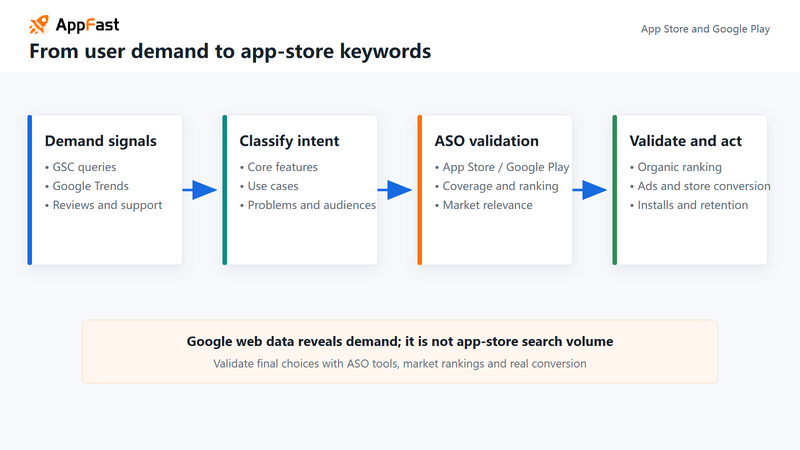
For example, users looking for an AI meeting-notes app may search the web for `how to transcribe a meeting`. That query confirms a meeting-transcription need. Before using it for ASO, the team should separately validate store-oriented candidates such as `meeting transcription`, `AI meeting notes`, and `voice to text` in the App Store and Google Play. Web data discovers the need; store data determines which keyword belongs in an ASO decision.
Metadata is localized by language; rankings are measured by market
To keep the examples consistent, this article assumes that an app uses the English (U.S.) localization and treats the U.S. App Store and Google Play as its main observation markets. This is only an example, not a recommendation that every developer should prioritize the United States. The right platforms, countries, and metadata languages depend on the app's users, commercial goals, and existing performance data. Even where several markets use English, the same keywords may perform differently.
Separate these dimensions:
- Base metadata is maintained by language localization. In the App Store, the main fields include the app name, subtitle, description, and keyword field. In Google Play, they include the app name, short description, and full description; there is no separate keyword field;
- Performance is measured by platform and country or region. The same English keyword can perform differently between the App Store and Google Play, and demand, competition, and organic rank may differ across the United States, United Kingdom, Canada, and Australia;
- Each platform has additional capabilities. Google Play, for example, supports custom store listings for selected countries, regions, and other targeting conditions. These serve specific localization or acquisition scenarios and do not replace base-language metadata.
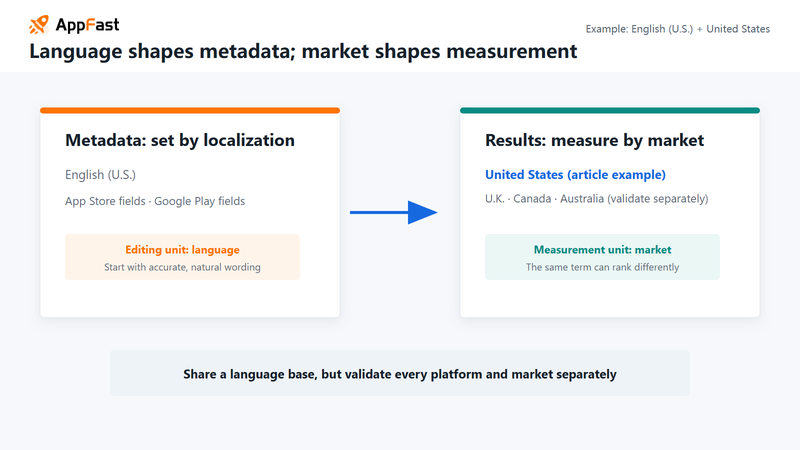
For the AI meeting-notes example, the team first defines the core feature language in English (U.S.), then checks keyword rankings and download conversion separately in the U.S. App Store and Google Play. When expanding to the United Kingdom or Canada, it can reuse the semantic foundation, but it still needs to evaluate local wording, competition, and ranking by platform and country.
The same rule applies to Japanese, Korean, Spanish, and other localizations: choose natural local expressions first, then observe performance in the relevant market instead of publishing literal translations of Chinese keywords.
Use AppFast to audit existing keyword coverage
Keyword research should not begin with unlimited expansion. It should begin with a simpler question: What does the current English (U.S.) metadata already cover, and where are the gaps?
AppFast's keyword coverage checker provides a practical first step. Do not evaluate only the number of covered terms. Group them by job:
- Core feature terms, such as `AI meeting notes`;
- Use-case terms, such as `meeting transcription`;
- Capability terms, such as `voice to text`;
- Audience terms for students, sales teams, or remote teams;
- Problem-oriented long-tail terms describing a task the user wants to complete;
- Brand and competitor terms for brand protection and comparison-demand analysis.
Once the terms are grouped, metadata weaknesses become easier to see. A title may contain several broad category terms while failing to express the main feature. The listing may cover `AI notes` but miss the more specific meeting use case. One English keyword set may also be reused across countries without checking country-level rank or conversion.
Coverage is not about placing as many terms as possible. It is about using limited metadata space for high-value search intent. In the App Store, inspect the app name, subtitle, and keyword field. In Google Play, inspect the app name, short description, and full description. Their fields and indexing logic differ, so an App Store keyword-field tactic should not be copied mechanically to Google Play.
If the audit is difficult to interpret, sign in to AppFast and add an account manager from the tool page for a free consultation. The team can help identify which metadata fields need attention on each store, which terms require further ranking observation, and which App Store candidates are suitable for validation with Apple Ads data.
Expand keyword candidates with AppFast, then filter them
After checking coverage, expand the candidate pool.
AppFast's keyword expansion tool can uncover related wording, use cases, and long-tail directions around a core term. Its output is a candidate set, not a ready-made metadata list. Every term should pass at least three filters.
The first is product fit: does the app genuinely deliver the capability implied by the term? Exposure will not convert when the product fails the user's expectation.
The second is intent fit: is the searcher looking for information, evaluating a tool, or trying to complete a task now? Store metadata should prioritize tool and download intent rather than covering every related topic.
The third is platform and market fit: does the candidate show the same demand in the App Store and Google Play? Is competition acceptable in the target country? Does the app already have a ranking foothold? English meaning can be reused across markets, but the final decision must return to the selected platform and country.
After filtering, classify terms into three groups: core keywords ready for the appropriate store metadata; candidates that still need platform data or a limited ranking test; and weakly relevant terms to set aside.
Put coverage, ranking, and conversion in one decision table
Looking only at an ASO keyword tool can leave the team stuck at "finding words." A keyword decision table connects each data pattern to a next action.
| Keyword status | What it may mean | Priority action |
|---|---|---|
| Highly relevant but not covered | A gap exists in the target store's English (U.S.) metadata | Update the App Store name, subtitle, or keyword field; update the Google Play app name or descriptions |
| Covered and ranked 11-30 in the U.S. | The store recognizes the term, but competitiveness is weak | Strengthen relevance for that platform and monitor rank |
| Strong rank but few downloads | The store page does not satisfy the search intent | Review the icon, screenshots, value proposition, and ratings |
| Strong ad or store conversion but weak organic rank | Conversion already supports the demand | Add the term to the platform's ASO and keyword-ranking plan |
| High popularity but persistently weak conversion | The volume is large, but the intent may not fit | Reduce priority or stop investing |
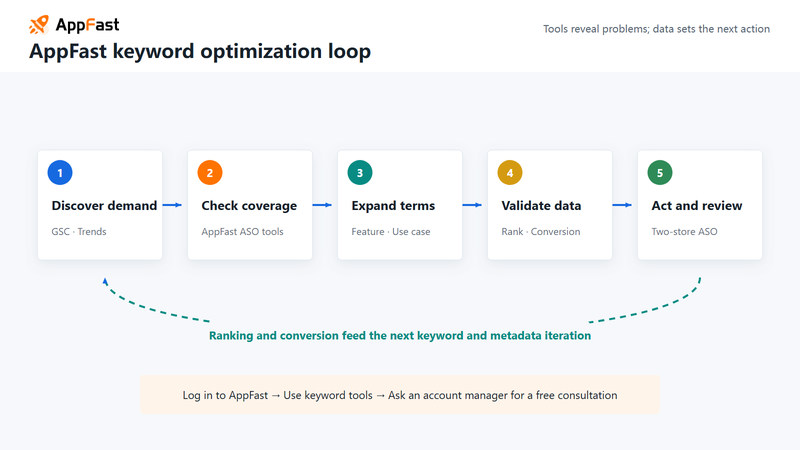
The table makes the next step explicit. Keyword optimization is no longer a one-time metadata edit; it becomes a continuous process of demand discovery, coverage audit, candidate expansion, data validation, and ranking-and-conversion review.
Validate demand with platform data, then feed it back into ASO
Organic rank indicates relevance and competitive position, but it cannot by itself show whether users will tap and install. The App Store and Google Play provide different evidence, so analyze them separately.
In the App Store, Apple Ads search-term impressions, taps, and installs can validate intent before a keyword moves into stable Exact campaigns, English (U.S.) metadata, or a custom product page. In Google Play, combine keyword-rank monitoring with Play Console store analysis and acquisition performance to evaluate store-listing visits and install conversion. Google Ads app campaigns can add acquisition and downstream-quality evidence, but their data should not be treated as organic keyword search volume.
The reverse signal also matters. If a keyword ranks well but paid and store-page conversion remain weak, revisit the match between the query and the product value. Ranking is not the final goal; acquiring the right users is.
AppFast's ASO, keyword-ranking, and download services cover both the App Store and Google Play. For App Store projects, AppFast can also provide Apple Ads account diagnostics and campaign services, connecting search terms, TTR, CVR, CPA, and organic rank. After signing in, add an AppFast account manager for a free consultation to identify whether the constraint is the platform, keyword selection, metadata, paid acquisition, or store page before choosing a service.
Why a covered keyword can still rank poorly
Coverage only helps a store understand relevance; it does not guarantee a high position. Competition, download signals from the target query, store-page conversion, ratings, and historical performance can all affect rank.
When a target term is present in metadata but remains deep in the results, check:
- Whether relevance is strong or the term appears only weakly in a long description;
- Whether the target-market store page for that platform matches the keyword's intent;
- Whether Apple Ads data is available for the App Store, or rank, store analysis, and conversion data are available for Google Play;
- Whether the current rank provides a realistic foundation for further improvement;
- Whether the app needs reasonable search-driven downloads from the target keyword;
- Whether organic installs also increase after the rank improves.
AppFast provides keyword-ranking optimization for the App Store and Google Play. It does not apply one volume and pace to every keyword on both platforms. The process begins by checking coverage, relevance, current rank, target-market competition, and page conversion on the relevant store, then creates a phased plan for selected terms. Store algorithms change continuously, so no fixed number of downloads can guarantee a specific rank. Careful keyword selection and ongoing monitoring make the investment more controllable.
If the team is unsure whether to change App Store metadata, revise Google Play metadata, validate platform data, or begin keyword-ranking work, it can sign in to AppFast and add an account manager for a free consultation before deciding the sequence.
Pre-publish ASO techniques checklist
- Have GSC, Google Trends, reviews, and support questions been used to map user demand?
- Have dedicated ASO tools validated candidates for the App Store and Google Play separately instead of copying web queries?
- Is the metadata language appropriate for the target market? The example in this article uses English (U.S.);
- Are keyword rankings and conversions recorded for the countries the app actually targets? The example here uses the United States;
- Does each core term accurately represent a primary product capability?
- Were the correct fields checked on each platform: app name, subtitle, and keyword field in the App Store; app name, short description, and full description in Google Play?
- Are feature, use-case, and problem-oriented long-tail terms covered?
- Are organic installs, keyword ranks, Apple Ads, or Play Console data being used to validate intent?
- Do screenshots and value propositions meet the expectation created by the keyword?
- Does every important term have an observation window and a next action?
- When entering another language or country, will the team recheck local wording and rankings?
Conclusion
The value of app keyword data is not identifying the biggest term. It is understanding what users want, which needs belong in the App Store or Google Play, where ranking growth is realistic, and whether a higher position produces real downloads.
Using the U.S. English market as an example, a complete process starts with GSC and Google Trends for demand discovery. AppFast then helps audit App Store and Google Play coverage, expand candidates, and combine country-level organic rank with the conversion evidence available on each platform. The result is a metadata, acquisition, or ranking plan built around validated terms.
If you already have a list of English keywords but do not know whether to optimize the App Store, Google Play, or target-keyword rankings first, sign in to AppFast, use the keyword tools, and add an account manager for a free consultation. Finding the constrained platform and stage before committing budget is usually more effective than chasing high-volume terms blindly.